Ma'mun Murod, From Writing to Becoming a Professor
For an activist, writing is one way that can be taken to revive movements, ground ideas and immortalize history. Likewise, the path taken by Prof. Dr. Ma'mun Murod, M.Si., who was active in organizations and wrote diligently while studying the undergraduate program at the University of Muhammadiyah Malang (UMM) several decades ago.
When met in the Chancellor's Room of the Muhammadiyah Civilization Center Building, the lecturer who now serves as Chancellor of the Muhammadiyah University of Jakarta (UMJ) told about his writing career which started in UMM's Bestari tabloid. With a chuckle, Ma'mun recalled receiving an honorarium of Rp. 15,000 for his writings which were published in small columns.
" Between 1992-1993, my writing was published in Suara Muhammadiyah, entitled Gaza Jericho First . After that, I was quite honored when my writing was published in the Pelita newspaper, a great newspaper, Islamic media, on a national scale. Once I send my writing, it is immediately loaded and becomes a single column. There is extraordinary pride, . "I copied (newspaper sheets) and distributed them in class," recalled Ma'mun.
The more he liked writing, the more articles Ma'mun tried to send to local newspapers. While studying for his master's degree at Airlangga University, his writing began to appear in national media such as Jawapos and several other media.
"I am grateful to Mas Maksum, the opinion editor of Jawapos, who gave me many opportunities to write. "In fact, my writing was once a single column, at that time it discussed PPP issues around 1997," said this lecturer who was born in Brebes, 13 June 1973.
Other media that have also published Ma'mun's writings include Fajar Sulsel, Koran Sindo, Kedaulatan Rakyat Yogya, Solopos, Suara Muhammadiyah, Matan, and Republika. One of Ma'mun's memorable writing experiences was when he first sent an article and became a single column in Koran Sindo in the early 2000s with the title "Gus Dur and Kiai Kampung".

His writings are often related to political issues, even though Ma'mun is actually a student at the UMM Social Welfare Study Program. His passion is not in Social Welfare, he said, but in Political Science. Therefore, his writings predominantly have political themes.
“ My passion is politics. Although, while studying at the Social Welfare Study Program, I actually wrote a thesis in political science. This was due to the greatness of the soul of the Dean of FISIP who was my mentor at that time. He can understand. I told him that it seemed impossible to write about Social Welfare issues and I had even looked for data about kiyai politics. "Finally, because we were both still in the social group , he allowed me to write a thesis about it," recalled this cadre who was active in IMM from the Commissariat to the DPP.
Ma'mun is a Muhammadiyah cadre with a Nahdlatul Ulama family background. His interest in the world of politics has grown since he was a child because he often heard stories from his Uncle, who was active in the PPP and was previously in Golkar. He said that Pakde, who at that time lived in Jakarta, had been in and out of prison several times and when he returned home, Ma'mun got a lot of stories about the political situation that was happening in Jakarta. Even as a child, he knew about the issues regarding the decline of President Suharto, who was supported not only by the student movement but also by businessmen.
The lecturer, known as Ma'mun Murod Al-Barbasy, also knows about political activities from his mother, who was active in the PPP. His mother, who was born and raised in the countryside (Ma'mun even called it ' village '), often invited him to take part in the PPP campaign in the run-up to the 1982 elections and was almost never absent. By the size of rural society, for him, the campaign at that time was carried out with extraordinary enthusiasm.
This alumnus of MA Negeri Tambakberas, Jombang, East Java, described the campaign atmosphere which was filled with campaign props in the form of a Kaaba mounted on poles. All the props were made independently, showing that his mother and the people in Brebes at that time had strong militancy even though they did not have enough political knowledge because the media was not like it is now.
This father of three children's interest in social sciences, especially politics, has also become increasingly sharp because he has loved reading books since he was a child. He even has a book collection with a personal stamp to mark his books. The stamp later became the cause of Ma'mun experiencing an unforgettable experience in his life.
The experience began when Ma'mun was called by the principal because two policemen had come and looked for him. The police came to investigate photocopies of magazine articles about Christianization that were pasted on electricity poles. And on the site there is a stamp of Ma'mun's name.
“At that time my mindset was still very scriptural. I once read an article in a preaching media about Christianization, I photocopied it and distributed it. I still remember it was Thursday, because I routinely fast Monday-Thursday. I pasted photocopies of the writing on electricity poles. "When I installed it, I didn't realize that my stamp was also printed," said the lecturer who completed his studies in the Political Science Doctoral Program at the University of Indonesia.
When he entered the principal's office where there were already two policemen, Ma'mun was immediately slapped by the principal and his eyes filled with tears. This incident forced his father to come immediately. Even though Abah very rarely visits his son in Jombang, where Ma'mun High School is located. Ma'mun said that his father's arrival in Jombang could be counted on one hand. According to him, Abah really understands his son's character. Even before entering high school, Ma'mun often received advice from Abah to always be careful.
Ma'mun's parents were Abah H. Ibrahim (late) and Mrs. Hj. Salamah never forbade her son from becoming an activist, but was very understanding and provided support. During his lifetime, the late Abah was Ma'mun's discussion partner when he was spending semester holidays at home, Brebes. The night, which lasted no more than 12 hours, was a long, quality night for father and son, because it was filled with political chatter. Almost every evening is filled with discussions.
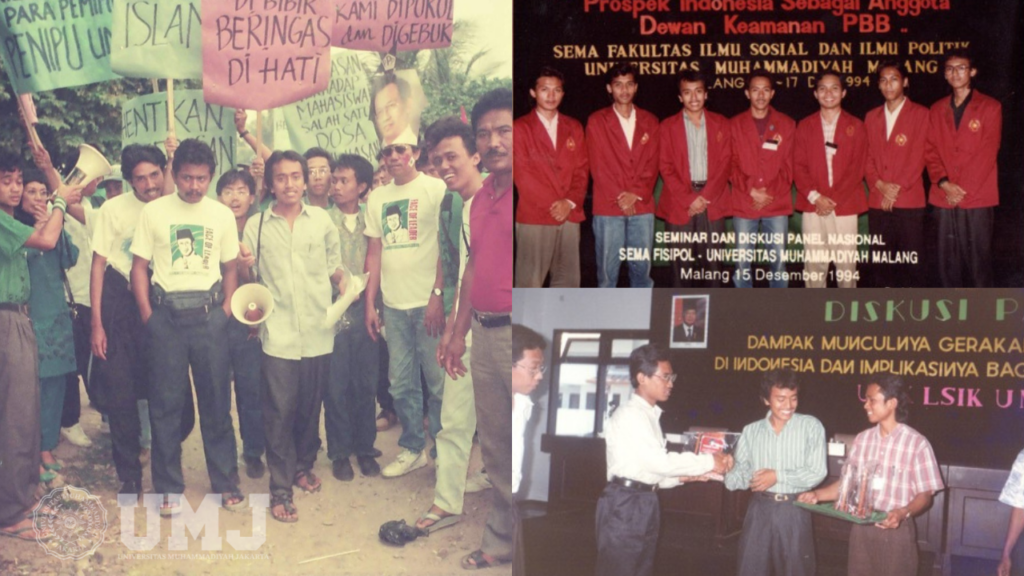
Ma'mun's activist spirit was formed naturally. While studying, he participated in various organizations, starting from the Muhammadiyah Student Association which was started by the UMM FISIP Commissariat to the Central Leadership Council, and Muhammadiyah Youth. Several other organizations that were followed included the PP Muhammadiyah Institute for Wisdom and Public Policy, the National Leadership of the Indonesian Movement Association, the Indonesian Ulema Council, and others.
The deeper he gets to know him, the more his views on politics develop. From previously seeing politics normatively, to now seeing politics more broadly.
“Previously, the thinking was just normative. Today, politics is pragmatic. That's what makes it difficult for us to understand. "In reality, we are told to be friendly with politics in the true sense, which is currently not normative," he said.
Even so, Ma'mun is still interested in getting involved in the world of practical politics. According to him, practical politics is a vehicle for testing himself. Several party names, such as the Matahari Bangsa Party, the Democratic Party, and the National Mandate Party, have become his political vehicles. In fact, not just a vehicle, Ma'mun together with the Muhammadiyah youth generation founded the Matahari Bangsa Party in 2006. The formation of the party was later published in a book entitled History of the Establishment of the Matahari Bangsa Party in 2008.
“Politics is not enough just on campus. This is a test of faith and a test of theory. You have to jump in. It's just that the risks of liberal politics make it impossible to enter politics without money. I was once a legislative candidate from the Matahari Bangsa Party, we were serious at that time about wanting to color Indonesian politics. But the reality is not the same, much different from what is taught on campus. What is certain is that I have never regretted joining politics. I was called and encouraged because those who were previously involved in BPUPK were professors, intellectuals who read and were involved in politics. "Now there are too many practices and not enough literature, unless politicians who have been activists will be different from zero," he said.
He still holds this belief firmly to this day. Even when he sat as Chancellor of UMJ. According to him, being a chancellor means being an officer who carries out political work to implement policies. Ma'mun, who was previously the Dean of FISIP UMJ, also believes that the chancellor is the person with the most freedom in speaking. Especially when he received the title of Professor, even though Ma'mun believed that this title was a necessity for people who worked as lecturers.
"When someone has become a professor, having completed their final education sometimes becomes an academic burden and a moral burden. Of course, being a Professor in the field of Political Science, I am required to adapt and respond to political developments. Meanwhile, the current political reality is like this. "That is my challenge to provide a constructive response," he said closing the interview session.


Komentar
Posting Komentar